
It feels like I haven’t posted in so long, though it’s only been a week or even less.
But when one gets busy, the mind can’t concentrate in too many things at once, can it?
By the way, this post isn’t about money.
They say creditors have better memories than debtors.
And of course, that makes perfect sense in the financial world.
The lender with the upper, steady hand would by all means save, register, and arrange all the details of the transaction.
On the other side, the borrower, with the lower, shakier hand, would delay, delete, or even freeze any memory of what’s owed or what should be paid back.
Right.
Now… do things work the same way in the non–financial sides of life?
In those close relationships — with family, friends, neighbours, and even those brief but meaningful acquaintances who pass through our days?
Would there still be creditors and debtors?
And if so, who would you think have a better memory?
Well… things happen, right?
But let’s stay on the positive side.
Love, kindness, forgiveness, and all the other beautiful traits we offer to those close, special ones — comes with no conditions, no deadlines for return, no legal action to take, and no double interest added for any delay.
So no— there are no creditors, no lenders in these relationships.
There are only the givers, with calm, warm hands,
who save a good memory with no alignment, no regret, and no remorse.
The receivers here are not borrowers with shaky hands.
No.
They are the blessed, the fortunate ones.
They can even hold a better memory than the givers, if only they honour kindness with gratitude.
Sometimes we just need to think positively.
even when the world seems to focus only on creditors and debtors.
So far, I am following the plan just fine—reading nonfiction.
Recently, I’ve started reading some psychology.
My first encounter with this subject was in my final year of high school, many years ago.
Honestly I remember nothing of those lessons except the teacher herself— even her name has slipped away. I remember her loud voice and sharp gaze, but I can’t get any closer to her name.
But I do remember the name of my teacher from my first year of primary school.
Strange, isn’t it.
I loved my first primary teacher and I wept buckets when she left and moved away with her husband.
Anyway, my psychology teacher crossed my mind as I stole a little time for reading. Time is tight these days, with Eid celebrations almost knocking on the door.
So… according to psychology, our memory machine is not only selective, but also clever and cruel. It doesn’t come with a button we can press to “save all” or “delete all.”
No.
It works professionally, by using its own unique selective strategy.
It mainly saves the things you like the most, hate the most, or the things that hold your full concentration and consciousness.
Memory is not like history, which keeps a record of everything, though sometimes with some alterations and even some big lies.
Memory is a trustworthy keeper. It writes the minutes of the things that truly matter in your life, even those small details, those passing emotions, or those quiet, special moments.
And sometimes, out of the blue, it brings back one of those memories from many years ago.
Something that can make you smile, cry, or simply wonder as time pulls you back in a split second.
You find yourself back in that classroom, learning psychology, having no idea that years later you would be reading a psychology book explaining why you can’t remember your teacher’s name.
Simply because you neither loved or hated her, your memory saved only what had caught your attention back then — the special tone of her voice and her sharp gaze
And… thanks to psychology, I found the little distraction that inspired me to write this post.
The most obvious choice is to keep going, to follow the crowd, repeat the same routine, and perhaps make the same mistakes, as long as things are not broken
But isn’t it a dangerous advice?
I heard its equivalent in Egypt. People say, “if it works, let it work.
Same meaning, right.
But what if it’s working badly or awkwardly or uselessly?
Yes, it’s working.
Yes, it’s usable.
And yes, it’s better than nothing.
But what’s wrong with fixing things that aren’t broken?
And first, do unbroken things really need any fixing?
Well… that depends on how you see things.
Fixing can mean replacing, discarding, or abandoning a thing or an idea or even a person.
But it can also mean rethinking, reshaping and reliving.
It can be an invitation to make some changes, some improvements to whatever we’re having or doing.
Imagine you have an old china cup with a few scratches, crakes, and maybe a broken handle.
You use it every day.
You drink your hot tea from it.
You wash it.
You dry it.
And you put it back in the cupboard safe and sound.
You keep it this way until its time comes when it either bursts or slips from your hands and smashs against the floor.
Some will throw it away.
Some will try to fix it by gluing its pieces back together.
In either cases, it will no longer be used for drinking or washing.
It becomes either a souvenir or goes straight into the bin.
So why couldn’t it become a souvenir a long time ago?
Because it wasn’t broken.
And what’s wrong with fixing it while it was still usable with giving it new ideas, new benefits, or even new memories?
Sometimes, we don’t just practise this easy-peasy strategy, but we believe in it.
If it works, let it work.
If it isn’t broken, don’t fix it.
Until it’s too late.
Until we finally realise that everything has its time…
This let’s pretend is all about close your eyes and dream.
Well… not closing your eyes and dozing off, but turning on the light to imagination, to hope, and perhaps even to happiness.
Children are the best at make- believe.
They use let’s pretend to dream about the future, about their growing-up lives.
They play this let’s pretend game to have fun.
They cling to this let’s pretend as a shield to avoid and escape punishment.
Writers make-believe too.
Their let’s pretend characters become full of life on the page.
Their let’s pretend thoughts turn into words a reader can hold.
And their let’s pretend world becomes real in imagination.
Pause…
This was how I began this post last night with this idea which I borrowed from a non-fiction book about creativity and IQ tests. By the way, do we really need all the fuss around them?
I don’t think so.
Now, back to the main idea.
Instead of going back to finish my post, I decided to complete Dostoevsky’s Poor People.
I did finish it, but that wasn’t a good idea.
Because I abandoned the post and slipped straight into reviewing the book.
But the idea of let’s pretend started nagging me, buzzing into my head, with a single plea;
Please let’s pretend you didn’t read the book.
Please finish the post.
I tried.
But, I couldn’t.
The book seemed to cut the flow of my post thoughts with its hopeless narrative.
It’s understandable how the story reflected the miserable and hard life the author experienced during the time he was writing it.
But still, I found myself wondering; why he didn’t play this let’s pretend game, just once, to make- believe some hope in the miserable story?
By comfort, I don’t mean idleness, an aimless life, or monotony.
By comfort, I mean choosing to follow what’s suitable for you while still having a target, a purpose, and even a moral compass.
The gardener, for example, who knows nothing but planting and selling flowers, is happy, content, and proud of his accomplishments.
Then one day, others introduce this idea of “comfort zone” into his mind.
They keep nagging him to get out of his comfort zone and take some risks:
to buy more land, plant exotic scentless flowers, and double or even triple the price of his harvest.
He says, “But my life is good, and I have risks everyday to take and challenge.”
They say, “But you can do more.”
He says, “I have enough.”
They say, “Who dares, win.”
He says, “win what? “
They say, “Fortune, wealth, and more pleasures.”
He says, “What about comfort?”
They say, “Well… they will bring comfort.”
He says, “No… there will be no time for comfort.”
They say, “You’re wasting your life.”
He says, “No, no… I’m enjoying my life.”
Is the gardener lazy or weak or brainless?
Do the others, with their idea of “getting out of the comfort zone,”live really in paradise?
Strange how most people ignore the fact that, in comfort, a person can be more productive, creative, and successful.
A comfort zone is not about sitting in a chair and crossing your legs.
A comfort zone can be full of options, challenges, and achievements.
It’s simply where and how you choose to live.
In the end, in your comfort zone, you have the freedom to follow your own intuition, and you are not obliged to say “Amen” to anyone’s else rules because… it’s a home, not a prison.
In case you, just like me, are shocked and disappointed by what’s happening around the world, here are some of my philosophical musings, not on politics, but on gambling.
Now… before making any assumptions, this post is inspired by Dostoevsky’s The Gambler which I’ve finished reading.
You know what?
A popular Arabic saying goes: Take the wisdom from the mouths of the insane.
You may wonder how.
Wisdom and insanity do not match, together they make no sense.
You’re right.
But… who says that the insane are wise, or that wisdom can be taught to the insane?
It’s not about knowledge or experience.
It’s about special gifts.
It’s an advice not to belittle anyone’s abilities, even if they were insane.
Back to the Gambler: the book was clearly written by a gambler with a warning as bright as sunlight in a clear sky. It seems to shout: avoid gambling, never try it, and flee from it.
Isn’t the gambler just another insane person born with a functioning brain, yet destroying it for the sake of gambling obsession?
The story echoes that old saying, with a bit of alteration.
It seems to urge readers; take the wisdom, and learn the lesson from the gambler’s tale.
Have you heard about the storm that hit the UK yesterday?
Goretti. That was its name.
By the way, it wasn’t all over the UK.
In my place, it was just cold, cloudy, and sometimes rainy.
Now ready to think about something else?
Have you heard the term brainstorm?
Of course you have.
With all due respect to dictionaries, the word explains itself.
Why do some people make things complicated?
I have no idea.
Simply put, brainstorm is like having a storm in your brain. Whatever form the storm takes; psychological, mental, spiritual, or something else, it usually stirs and blows with new ideas, and perhaps new solutions too.
So… this kind of brainstorm is just like a weather storm. It can cause a sudden flood of ideas and energy that turns on every fuse in your brain. And then, suddenly, you see new things and find new solutions, and feel, absolutely, elated.
But sometimes a brainstorm means totally the opposite. That’s when it blows everything away, and causes both a power cut and long delays. In this case, things feel blurry and dull, and you end up feeling more confused and lost.
Perhaps the navigation of a brainstorm depends on a person’s mood, or maybe on their motivation. But sometimes, it also depends on determination.
Dont’t people say that if there is a will, there’s a way?
And they also say; after every storm, the sun will smile again.
So whether the storm turns on the light or cut it off, it will pass, and when it does, we’ll all glow with relief and joy.
Over 2025, I often ended my posts with ”with hope and peace.”
Did you notice that?
Actually, I am not sure if it started at the beginning or somewhere halfway through. It just slipped there one day at the end of a post, and I stayed with it.
It was a desperate attempt to support innocent people who have suffered and are still suffering all over the world, simply to live a safe and decent life.
Perhaps… you can think of it as a whispered prayer— one you, as a reader, might feel and answer by whispering back ”Amen.”
You know… ignorance isn’t just the lack of study, learning, or certificates.
No, ignorance is the lack of understanding, of seeing and feeling what is true and real.
By the way, don’t you agree that education is not the opposite of ignorance? In other words, a farmer with basic education may have more knowledge than a qualified teacher. The farmer’s knowledge is usually enriched by wisdom, while the teacher’s is measured by certificates.
So… can we agree that the opposite of ignorance is understanding?
Education, power, wealth, and fame do not necessarily produce knowledgeable people. Ironically, these supposed sources of knowledge feed and entertain ignorance more than they cultivate true knowledge.
And this type of ignorance is available in abundance, but it is deaf and blind.
It spreads lies, hides the truth, and fights against cultivating knowledge.
That’s why ignorance is cruel, so cruel indeed.
But there is some good news. Over the years, ignorance has always surrendered to knowledge. Not only that, this cruel ignorance has lived by the light of knowledge, yet it never recognised its validity until it was too late.
All we need to avoid falling into the trap of ignorance is to understand, and to see and feel things not only with our minds, but also with our hearts.
And…
Remember, knowledge is understanding, and understanding is the first step towards wisdom, and wisdom is light, and there’s always light at the end of the tunnel.
Well… this is not astronomy or astrology or astrophysics. I have nothing to do with any of those.
I simply think of stars as stars; luminous lanterns created to shine in the sky, to guide, or once used to guide, our ancestors across land and sea all over the globe.
Strange how little we see of them nowadays. They still exist in abundance up there in the sky, but most of us are busy, mainly chasing human stars, brand stars, evaluation stars, review stars, and those golden and silver stars. But those literal stars cannot compare to a single luminous creature shining up there in the sky. Its distance, its quality, its meaning, its light, its power, its mystery, all are beyond compare.
In olden times, when human life was deeply connected with those sky lanterns, people personified them as the best of the best. Those far away stars were friends, listeners, watchers, consultants, lovers, and more. Poets wove them into poetry. Travellers took them as companions. Workers waited for them. Children counted them. Lovers dreamed beneath them. Even animals and birds nestled into their places with the first sight of them.
Have you ever noticed how real stars rarely appear amid noise? You have to seek them in quiet, simple places ; on mountains, by the sea, across dessert sands, or anywhere tranquil. Their silver light is a treasure, revealed only to those who pause to appreciating it.
Now what do you think about the stars?
Here’s a verse from Gibran’s poem,
“The sorrow of the soul is nothing but an illusion, that doesn’t last, and the clouds of the soul reveal the stars within its folds.”
Can you see that the stars symbolise the light that can be seen even in the most greyest and darkest night—yourself?
I haven’t finished it yet, and I have only myself to blame.
Do you know why?
Imagine you decide to join a marathon even though you know you’re more of a walker. You’re not slow, but you simply like to take your time, enjoying the scenery and your surroundings.
So I began my 2025 reading marathon with a plan to finish 60 books.
Of course, at the start line, I was full of enthusiasm, energy, and dedication, but things always happen.
A few months later, the target began to feel unrealistic, especially as doubt started whispering logic into my head, equipped with sensible calculations and reasons.
I dropped my challenge to 50 books, and slowed down running.
Halfway through the year, a few complicated books challenged my target, and made me feel as if I were running up a steep hill. And don’t forget, I’m not really a runner. So, I changed to jogging instead, and dropped my challenge to 40 books.
Now, it’s almost the end of the year, and I have no plan to drop the number again.
My score is so far 33 books.
If I make it, I make it.
If not, I’ll make a sensible plan for 2026.
At least that’s what inspired me to write this post.
With hope and peace,
Nahla
P.S.S
Please don’t be disappointed or discouraged by this post. I hope as much that you will read it as I hope you will fulfil your own reading challenge target.
And it’s sunny and warm. You could say… it is neither warm nor cold.
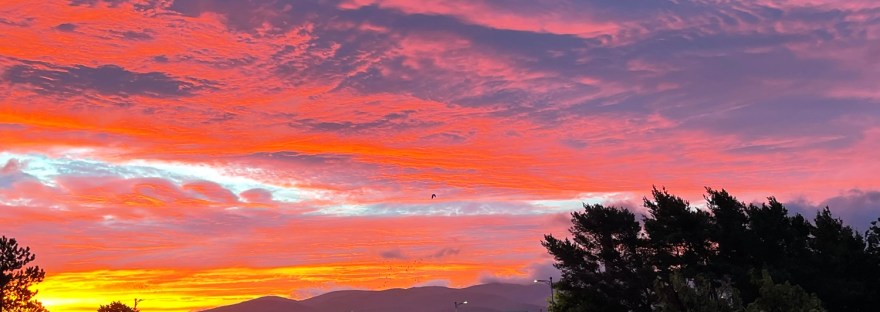
And it’s cloudy, and what beautiful clouds we have today; grey, white, and golden yellow. A stunning portrait of natural beauty!
And it will be rainy ( a bit later.) Still let’s imagine it; drizzles then light then heavy showers.
And it’s a busy morning: wind rustling, birds soaring and singing, trees swishing, cars racing, buses braking, children hollering, road workers drilling, and aeroplanes whooshing through the sky. What a real, live soundtrack!
Won’t this beauty make you happy, make you alive, make you feel blessed?
How many times do we have this beauty all together, all at once?
Sometimes all we need to do is to set aside whatever we’re doing, stand by the window, and simply look around.
“Anyone who requites faith and friendship as I did, will have to pay for it.”
The Professor’s House by Willa Cather.
I’ve already shared my review of this novel, and this quote has inspired me to write this post.
The reason behind this quote was the loss of a friend —not through death, but through disagreement and disappointment. One was an idealist, the other an opportunist. Though they made good company together, at the first conflict, their paths parted. It was the idealist who said these words, lamenting the loss of true friendship to uncompromising ideals.
Faith and friendship are such precious gifts— too precious to be returned, too fragile to be repaired.
One is blessed to have them strong, and to keep them safe and nourished.
How strong? How safe, how nourished?
The balance depends on how much you are committed.
Along this journey,
perfection and idealism are neither required nor recommended.
Materialism, modernism, and other -isms have no place here.
These precious gifts need a simple home with strong pillars.
Understanding and sincerity can be the main pillars.
But, if the pillars break, the building will collapse.
Then, regret follows,
and what a heavy, merciless creditor regret can be!
In brief, this is my interpretation of the quote, which I see as the bulb of the book. And perhaps you might think of it as… just a pat on the shoulder on the first of December.
Well, I have. Otherwise, I wouldn’t be writing this post right now.
Now, let’s think of common opposite words such as… tall and short. But, actually, the word tall has more opposites than just short.
There are, for example, little, small, petit, and others. Not to mention how you can make an opposite of tall through figures of speech by using, for example, dwarf.
Besides, tall is not only about height, for it can be used to describe a difficulty, for example, a tall task. In this case its opposite would be easy or simple. By the way, I hope my posts are not too tall.
Don’t think that this is a grammar lesson, because it’s not.
It’s just about the idea of flexibility and perhaps… possibilities.
If a word has many synonyms, why should you be stuck with one opposite when you have other choices that can express meaning in different contexts.
And this is simply another way to avoid embarrassment, monotony, or misunderstanding.
Hopefully, you’ve got my point.
If not… think of how the word opposite itself has more than two opposites and, ironically, synonym is its most popular opposite.
How many times have you dreamed of things, impossible in your mind, yet one day they do come true?
Sometimes your dreams seem just like… the mountain summit; too hard to imagine, too far to climb, and too impossible to reach.
But then, one says, “I have a dream,” while another says, “these are just fussy, meaningless dreams.” The difference between them is that one truly begins climbing the mountain to achieve something, anything, while the other waits down there, laughing, still wondering what a silly, unfathomable dream might be!
For the climber, to reach the summit, to cheer from up there, to enjoy the panoramic view all around from the top, is worth every step, every ache, and every drop of sweat. From now on, there will be no turning back, only moving forward—for every dream can come true.
For the others watching from down there, they wander about with mocking laughter, a few steps, a little effort, and no sweat. Poor them, they can’t see what the climber sees, they will not learn what the climber learns, and they will never understand how dreams can come true.
By the way, don’t you agree that to have a dream doesn’t necessarily mean becoming a president, a royal, or even a scholar? To have a dream is to have a purpose with valuable meaning. In other words, a dream has to do with something that can guide rather than mislead. It is a disaster if selfishness and pride are the sole motivations behind one’s dreams; actually this can be worse than having no dreams at all.
Do you remember those old days dreams?
As children, we were often asked, “What do you want to be in the future?
Do you remember the boy who said, “I want to be an upright judge.”
And the other who said, “an honest lawyer.”
And that girl who wanted to be a kind teacher. And another who dreamed of becoming a merciful doctor.
These little noble dreams often came true, turning into something useful, generous, and prosperous.
Now, please do not to be pessimistic for even amid all the media madness and money mania, these little noble dreams still exist.
There will always be those who surprise us with true, prosperous dreams coming true.
“If the fish comes out of water to tell you the crocodile is ill, believe it.”
I came across this sentence while I was scrolling through instagram.
Is it a puzzle? I wondered, and decided that the only way to find out was to see how writing might solve it.
But first: have you ever come across this one before?
I’m just curious about its origin.
So, let’s set the scene first.
An old wise man was walking along the riverbank just after dusk. (Now, don’t ask me why an old man. I really don’t know, it just came that way into my head. Besides it sounds better than “an old woman” in the context of a quiet, dark background. And don’t ask why wise. Actually … I can see your point. Not every old men behave wisely. But, at lease let’s make them wise in stories. Now not more interruption, please.)
Once upon a time, an old wise man was walking along the riverbank just after dusk, as the last reddish ray of the flaming sun sank deep behind the big, dark mountains. He was having his usual evening walk by the river. Whether it was cold or warm, rainy or dry, busy or quiet, he never missed this routine unless something serious held him back.
On every evening walk, the old man had a plan—a simple plan to make a kind deed.
Sometimes he gave a stray cat some food,
sometimes he picked up litter and dropped it in bins,
sometimes he helped a mother get her baby’s pram onto the bus,
sometimes he sat back on a bench and patted another old man on the back as he listened to his heartbreaking story,
and sometimes he tried other gestures of kindness.
Until the day he took his evening walk by the riverbank, when it was extra quiet. The only thing he glimpsed that evening was a faraway, shiny golden fish bouncing on the beach.
The fish was the size of a medium salmon. He glanced right and left, wondering whether anyone might run and catch her for their dinner, but there wasn’t a soul around.
He rushed towards the fish, not to make her his dinner, but to push her back into the water so she might live. When he was about a metre away, she made one great bounce into the air, and spoke in a human voice: “The crocodile is ill.” As she landed on the damp beach, a high tide crept forward and swallowed her back into the deep river.
The old wise man stared into the deep river under the dark sky, wondering whether he was dreaming. After a few long moments of silence, he turned and walked back towards the road.
“Even if it was all a hallucination… what does ‘the crocodile is ill’ mean?” He wondered, and sat on the nearest wooden bench.
“If the crocodile is ill, perhaps it means the world is finally safe. People can go out and about with no fear, no threats, no weapons. Perhaps, now they can swim into the river and get rid of it. Then, life will be safe, fishing will be abundant, and people will be free.
“Or… if the crocodile is ill, it may be a warning of danger, awful danger. The river is no longer pure, no longer clean, no longer suitable for life. Not because of the crocodile but because of the river itself. Its water may be polluted, and the land no longer fit for living.”
A moment later, a young man drew near him and gently whispered, “Aren’t we blessed to have this beautiful river…. Tomorrow we’re going fishing.”
This is not about seas, oceans, rivers, or any natural or artificial forms of water.
By the way, don’t you agree that artificial rain feels fake in movies, but real in books? Or am I the only one who feels that?
But why wouldn’t you agree?
Don’t you use your senses more deeply when reading than watching?
Well, I do.
Imagine the difference; instead of taking things for granted in a movie, think of how your mind creates a world of its own while reading. It has many functions to perform throughout the reading episode. It reads, listens, talks, colours, breathes, moves, builds, plants, and does even more creative things.
Hopefully now you get my point.
Now back to ‘deep’, where else can we use it?
Well, what just crossed my mind is books, or literary works in general.
Sometimes we say: it was a deep book. This is either because we understand nothing … or because it moves us deeply.
Honestly, if I don’t understand a book, this means I found it dull, obscure, but never deep.
But, may I make a confession?
One day after reading a book I found it… different, and decided, for the first time, to leave a comment.
What do you expect I wrote?
“That was a deep book.”
To this day, I have no idea how I linked ‘deep’ to a story that was, for me, simply different.
How annoying and embarrassing!
Ever since, I’ve been thinking twice before using ‘deep’ to describe a book.
Throughout my reading, I’ve found that when a book moves you, it doesn’t necessarily mean crying buckets, dreaming happily at the ending, or grabbing the dictionary to search up most of its terms.
It’s more about the meanings, the voice, and perhaps the message of the work. The elements that urge you to think, to learn, or to understand things you have’t known before.
In other words, it not just about reading catchy content, but about drawing lessons from it.
This is one of the most special and poetic expressions in the Arabic language.
Isn’t it beautiful?
And what a brilliant choice to use talk and see!
When you talk, you simply… talk, spontaneously, casually, using your voice, your feelings, your words. In other words, when you become you, the other can hear, see, and know the real you better. Whatever you are and whatever experience, profession, or talent you have, the other can’t see any of it until you talk.
But things doesn’t rely only on the one who talks; listeners have their important share too. A listener’s good eyesight and hearing are not enough if they really want to see the one talking. To really see someone, is to use your heart. That’s why the blind and the deaf can see you as well as anyone else.
Not everyone who listens, truly listens. Have you heard of this saying before? May I make this tiny addition: Not everyone who listens, truly listens —or truly sees.
Even when you read a story, you come to know the characters better through their dialogue. The more they talk, the more you see them, unless you’re not interested in the book at all.
By the way, don’t you agree that writing is one of the most creative and artistic ways of talking?
I do—for some people, talk flows more in writing, and see deepens more in others’ writings. These are the same ones who believe talk lives in writing, and see broadens through others’ writings.
Isn’t it such an elegant word with supreme qualities?
Isn’t it special given to the special?
But praise is not for everyone or everything. Even your beloved ones cannot receive your full praise because they are humans and humans are … human. So, the first and foremost praise is always given to the Almighty. And how simple, pure, and beautiful it becomes when offered from the heart.
We humans love praise, but things may get out of control or even become abnormal.
Starting with ourselves, don’t you entrain yourself with a little praise now and then. Well.. I do, of course, not in public but … quietly, mostly to myself, and sometimes with my family. They usually laugh, but then admit it’s a good tactic for loving yourself.
But when your self-praise begins to puff up with conceit, you cross the limits and enter the dangerous phase of greatness insanity. So, be careful.
Then there are your beloved ones. Out of love and most of the time, you see them, or what they are doing as worthy of praise. How true and funny is this Arabic saying: the mirror of love is always blind.
But can you praise someone even if you don’t like them? I think that’s how we prove to ourselves that we play fair. For example, you might praise someone for their beauty, intelligence, etc, even if you cringe every time you see or hear about them, as if you were eating a sour lime. (By the way my mouth’s already watering for I used to eat limes like oranges.) But that’s fine, because you’re being sincere to them and to yourself.
Now, what about praising someone you don’t like for qualities they don’t have? That’s nothing but hypocrisy. Unfortunately hypocrites deform and misuse the very connotations of praise. They grow and spread like weeds, showering those who deserve nothing, everything. Ironically, they themselves would never trust any praise.
I believe we all do, but… perhaps some may say no, but of course they owe us some explanation or reason when they decide to shock us by their unexpected NO.
So, let’s remain with those who love flowers:
some plant them,
some pick them,
some sell them,
some buy them,
some are offered them.
And… some simply watch them.
Don’t you agree that the one who knows flowers best is the one who plants them? But who else can understand them so well?
And… don’t you agree that the one receiving flowers is someone so special? Do you remember that bouquet you get on Mother’s Day, your birthday, your engagement, or your wedding day? Flowers are for someone dear. Someone remembered. And someone loved. Right?
As for the picking, buying, and selling that’s all business with sufficient knowledge.
Have you ever dreamed of being a florist, owning your own flowers boutique?
I had that dream years ago until the day I stepped into one of those nice shops. Since then, I changed my mind. Why? Because I found the place so humid and stuffed, and I can’t endure either. Besides… imagine a customer asking for a posh, sophisticated bouquet, and getting a simple bunch of roses instead. That’s how I would usually handle orders if I were a florist.
Now what about those who simply watch the flowers? Aren’t they just like birdwatchers? They are the ones who appreciate things as they are, where they are, and when they are. The sight of colourful blooms on tall trees, in small pots, or scattering across meadows make them smile, sing, or even dream. This doesn’t mean that flowers look dull in vases, or add no beauty indoors. They do paint a beautiful and cheerful image in every room. But, the thing is flowers look more alive, vibrant, and real in nature —their vast, open home.
There are some flowering branches beside a big tree in our front garden. Sometimes, I wonder whether they will grow into a tree of their own. They blossom in the spring with a few dark red roses. When I saw them, I want nothing more than to pick them and place them in a vase indoors. But then, I think … the branch won’t look the same every time I draw the curtain and gaze outside. The branch will look so plain, perhaps sad and lonely, without them. So I leave them happy outdoors, to keep me happy indoors.
Good deal, right?
There is nothing more beautiful than watching birds spread their wings and soar high in the sky, and seeing flowers bloom, sway, and breathe everywhere.
Have you ever heard this quote: “Nothing happens, and nothing happens, and then everything happens.” I came across it in one of my reading books, and I hope I’m quoting it right.
Don’t you like it?
How many times have you been on the verge of giving up? Of letting despair and misery eat you up? Of bowing and kneeling before tyrants and demons? And why all that? Just because nothing happens. And nothing happens.
But then, Hope arrives and knocks on your locked door. He doesn’t wait for you to open it for he knows you have been waiting, suffering, and tormented for so long. He seeps into your dark, wretched soul like a gentle, warm breeze filling a dark, damaged home in a freezing night. That’s when everything happens: Prayers are answered, dreams come true, wishes granted, problems solved, and victory attained.
Isn’t that so beautiful, so encouraging—lifting the spirits of poor souls, awakening their self-respect, and strengthening their love for life?
There is a similar meaning in an Arabic poetry verse I once read. It says: “Things grew tight, and tighter, and tighter until they reached their tightest peak. Then, they began to loosen, and relief came.“ (This is my own translation.)
Are you are still reading?
If you are, may I ask you to think of the english quote, or the Arabic verse, in a different way?
Did anything come to your mind?
Let me give you an example to help.
Imagine, just imagine, you’ve been… God Forbid, a thief or a murderer or even a scammer your whole life. And nothing happens. And nothing happens. And, one day, you hear knockings at your door.
Hope is not the visitor this time. It’s Justice crowned with her royal, majestic halo. She’s the one who’s been waiting for so long. Finally, it’s time to make you pay. And then, things happen. But, instead of the gentle, warm breeze, it’s tsunami rushing to wipe you out, and reclaim everything that was never yours.
The interpretation is the same in the Arabic verse, with a slight difference. This time, it’s the culprit who tightens things with every deed, inhumane ones, of course, chasing success, power, and protection. He climbed to the tightest peak of pride, power, and false security. Then things happen. Tight things burst, don’t they? But relief doesn’t come. Only torn pieces remain this time, bringing nothing but suffering, humiliation, and regret.
Isn’t ”Pioneer” a great word filled with imagination, courage, and perseverance? Of course it is. A pioneer is a risk-taker, driven by promises of abundant profits. That’s all wonderful. Right?
By the way, I’ve just finished O Pinoneers! novel by Willa Cather. The title is really intriguing and summarises all the story. If you want to know a bit about it, you’re more than welcome to check my post on my book review blog.
But not all pioneers are the same, wouldn’t you agree?
Some claim the title but not the honour. Some deserve both the title and the honour, yet are, sometimes, denied them by the first category of pioneers who care more about status than substance. And then… there are those quiet pioneers, living the pioneer life without even knowing they really are.
Confused?
But why?
That’s so obvious, especially when it comes to the first two categories. It’s not hard to find them. They are everywhere, bragging about their “great” achievements and unlimited wealth and power as if that’s what a pioneer should mean.
As for the third, those are the ones who mind their own business. They are wise enough to change themselves before marching out loudly to change the world. They watch the madness around the world, yet go on working, writing, and appreciating life. And… they ask, quietly: what good comes of being a pioneer without self-respect, without inner peace, or without humane compassion?
In case no one’s told you this before: if your imagination, courage, and risk-loving spirit drive you away or back or forward, out of the madness and straight into a simple, quiet life then you are a special pioneer in this “chaotic” world.
Amity is about harmony, peace, and goodwill, wherever you find them. You might find it hidden between the lines of a book, or expressed as a simple thought in a post, or wrapped as a warm greeting in a text message.
But you know what? Amity is becoming rarer and rarer these days, but that’s not its fault. Noble qualities don’t go out of fashion. They don’t become extinct. They are just … not loud, not showy, and definitely not fake.
So, amity is one of those noble qualities that love to build, rebuild, and rebuild. In other words, if mistakes or wrongdoings break part of it, apologies and sincerity can mend it. It can wait, accept excuses, and even fix broken things, but not forever. It may lose its cheerfulness, its patience, but never its light.
And there’s something special about amity. It can melt lead, soften hearts, and overcome even the fiercest enmity.
Have you ever heard of the adage: “After enmity comes love?” By the way, it is well known in the Arabic world. But… honestly, I think this kind of transformation needs miracles. I believe in divine miracles. And, I believe only God knows which enmity can be softened into amity, and which heart is truly open to love?